
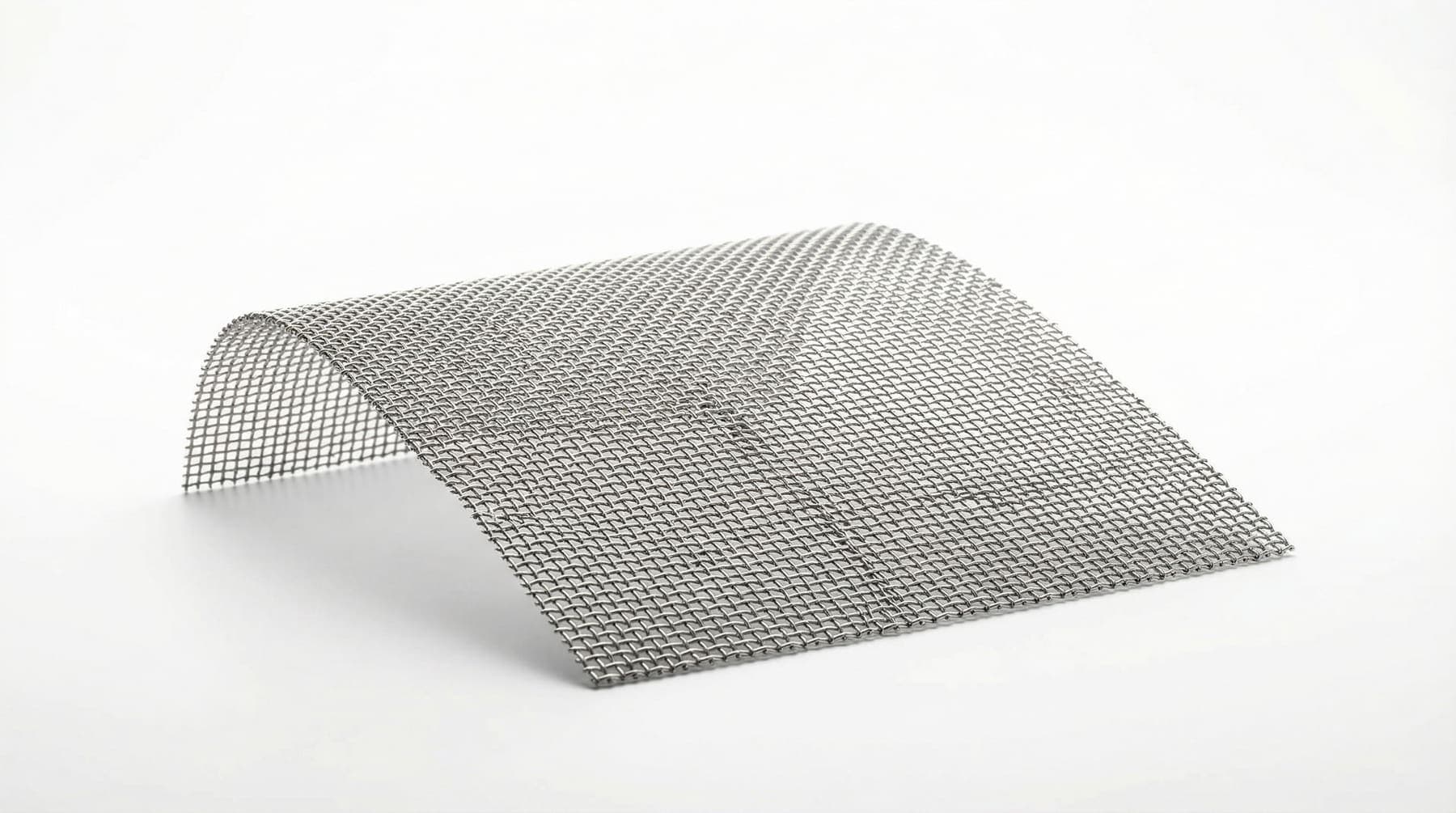
Aluminium Wire Mesh
5154 Alloy & Powder Coated Mesh Solutions
Overview
Lightweight woven aluminium mesh with excellent corrosion resistance, highly durable, and easy formability — one-third the weight of steel
Will corrode in contact with alkaline solutions and hydrochloric or hydrofluoric acids
Applications
Common Alloys
Properties
Manufacturing Process
Step 1
Wire Drawing
5052/5056/6061 rods are drawn through progressive tungsten-carbide dies, reducing diameter in stages to the specified wire size (0.1–5 mm).
Step 2
Annealing
Drawn wire is annealed to relieve work hardening, improve flexibility for weaving, and achieve a bright, oxide-free surface finish.
Step 3
Weaving / Welding
For woven mesh: warp and weft wires are interlaced on a mechanical loom to the specified aperture. For welded mesh: wires are resistance-welded at intersections.
Step 4
Tensioning & Flattening
Mesh is stretched on a tensioning frame to ensure flat, uniform aperture dimensions and eliminate any waviness from the weaving process.
Step 5
Cutting & Edge Finishing
Rolls are slit to standard widths on rotary shears; edges trimmed and selvedged or bound to prevent wire unravelling.
Step 6
QC & Packaging
Aperture, wire diameter, and mesh count verified by optical measurement; salt-spray corrosion test samples taken; rolls labelled and packaged.
Step 1
Wire Drawing
5052/5056/6061 rods are drawn through progressive tungsten-carbide dies, reducing diameter in stages to the specified wire size (0.1–5 mm).
Step 2
Annealing
Drawn wire is annealed to relieve work hardening, improve flexibility for weaving, and achieve a bright, oxide-free surface finish.
Step 3
Weaving / Welding
For woven mesh: warp and weft wires are interlaced on a mechanical loom to the specified aperture. For welded mesh: wires are resistance-welded at intersections.
Step 4
Tensioning & Flattening
Mesh is stretched on a tensioning frame to ensure flat, uniform aperture dimensions and eliminate any waviness from the weaving process.
Step 5
Cutting & Edge Finishing
Rolls are slit to standard widths on rotary shears; edges trimmed and selvedged or bound to prevent wire unravelling.
Step 6
QC & Packaging
Aperture, wire diameter, and mesh count verified by optical measurement; salt-spray corrosion test samples taken; rolls labelled and packaged.
Chemical Composition
EN 573-3 / AA
Max % unless range shown. Balance: Al.
| Alloy | Chem. Symbol | Si | Fe | Cu | Mn | Mg | Cr | Zn | Ti |
|---|---|---|---|---|---|---|---|---|---|
| 5154 | AlMg3.5 | 0.50 | 0.50 | 0.10 | 0.50 | 3.10–3.90 | 0.25 | 0.20 | 0.20 |
| 5052 | AlMg2.5 | 0.25 | 0.40 | 0.10 | 0.10 | 2.2–2.8 | 0.15–0.35 | 0.10 | — |
| 5056 | AlMg5Cr | 0.30 | 0.40 | 0.10 | 0.05–0.20 | 4.5–5.6 | 0.05–0.20 | 0.10 | — |
| 6061 | AlMg1SiCu | 0.40–0.80 | 0.70 | 0.15–0.40 | 0.15 | 0.80–1.2 | 0.04–0.35 | 0.25 | 0.15 |
| 1350 | E-Al99.5 | 0.10 | 0.40 | 0.05 | 0.01 | — | — | 0.05 | 0.03 |
Overview
AA 5154 aluminum wire mesh is a woven mesh manufactured from Al-Mg alloy wire. It is selected for applications where low weight, corrosion resistance, toughness, and non-magnetic performance are required. The alloy family is used in insect screens, vent mesh, grill cloth, marine and shipboard shielding, filtration, architectural mesh, fencing, and general industrial protection.
- Lightweight non-ferrous construction with low dead load.
- Natural corrosion resistance suitable for humid and marine atmospheres.
- Non-magnetic and suitable for electromagnetic-sensitive installations.
- Good formability for cutting, crimping, fabrication, and installation.
- Available in plain weave, welded mesh, and custom apertures.
- Supplied in rolls, cut lengths, or customer-specified packaging.
Alloy / Grade
| Grade | Alloy Family | Typical Composition / Notes | Typical Use |
|---|---|---|---|
| AA 5154 | 5xxx series Al-Mg alloy | Nominal Al-Mg-Cr alloy; typically ~3.1–3.9% Mg and up to ~0.25% Cr, with the balance aluminium and controlled trace elements. | Wire mesh for screening, shielding, filtration, fencing and industrial protection. |
Specification
| Category | Wire Mesh |
| Material | Aluminium Alloy 5154 / 5154A |
| Mesh sizes | 18 × 16, 14 × 14, 18 × 18 |
| Available widths | 2 ft, 2.5 ft, 3 ft, 3.5 ft, 3.75 ft, 4 ft, 4.5 ft, 5 ft |
| Roll length | 100 feet |
| Minimum order quantity | 1 roll / 100 square feet |
| Packaging | Rolls or as per client requirement |
| Applications | Domestic / Agricultural / Industrial |
Typical Applications / Usage
- Security screens for windows, doors and access openings.
- Sifting, screening and particle separation.
- Machinery guards and operator safety barriers.
- Sign panels and lightweight support substrates.
- Windows, hardware fittings and protective enclosures.
- Poultry farms, animal enclosures, zoos and containment structures.
- Power plants, factories and industrial safety applications.
- House fencing, perimeter protection and ventilation systems.
- Filtration, containment and architectural infill panels.
- Marine, shipboard and cable shielding applications where corrosion resistance is required.
Recommended Product Positioning
Aluminium Alloy 5154 wire mesh is best positioned as a corrosion-resistant, lightweight, non-magnetic mesh solution for screening, protection, enclosure, and industrial separation duties. It is suitable for customers seeking a durable alternative to heavier ferrous meshes in humid, coastal, or maintenance-sensitive environments.
Types of Weave
Each wire passes alternately over and under the wires it crosses, in both directions — the most common and versatile wire mesh weave.
Additional weave patterns (e.g. Twill, Dutch weave) pending further reference material.
Mesh & Wire Gauge Chart
| Mesh | Wire Dia (SWG) | Wire Dia (mm) | Opening (mm) | Open Area % |
|---|---|---|---|---|
| 1 | - | 3 | 22.4 | 77% |
| 1 | - | 2.5 | 22.9 | 81% |
| 2 | - | 3 | 9.7 | 58% |
| 2 | - | 2.5 | 10.2 | 64% |
| 2 | 14 | 2 | 10.7 | 70% |
| 3 | - | 2.5 | 5.96 | 49% |
| 3 | 14 | 2 | 6.46 | 58% |
| 3 | - | 1.5 | 6.96 | 67% |
| 4 | 14 | 2 | 4.35 | 46% |
| 4 | - | 1.5 | 4.85 | 58% |
| 4 | 18 | 1.2 | 5.15 | 65% |
| 4 | 20 | 0.9 | 5.45 | 73% |
| 5 | 14 | 2 | 3.08 | 36% |
| 5 | - | 1.5 | 3.58 | 49% |
| 5 | 18 | 1.2 | 3.88 | 58% |
| 6 | - | 1.5 | 2.73 | 41% |
| 6 | 18 | 1.2 | 3.03 | 51% |
| 6 | 20 | 0.9 | 3.33 | 62% |
| 8 | - | 1.5 | 1.67 | 27% |
| 8 | 18 | 1.2 | 1.97 | 38% |
Looking for fine wire specifications too?
View Aluminium Fine Wires