
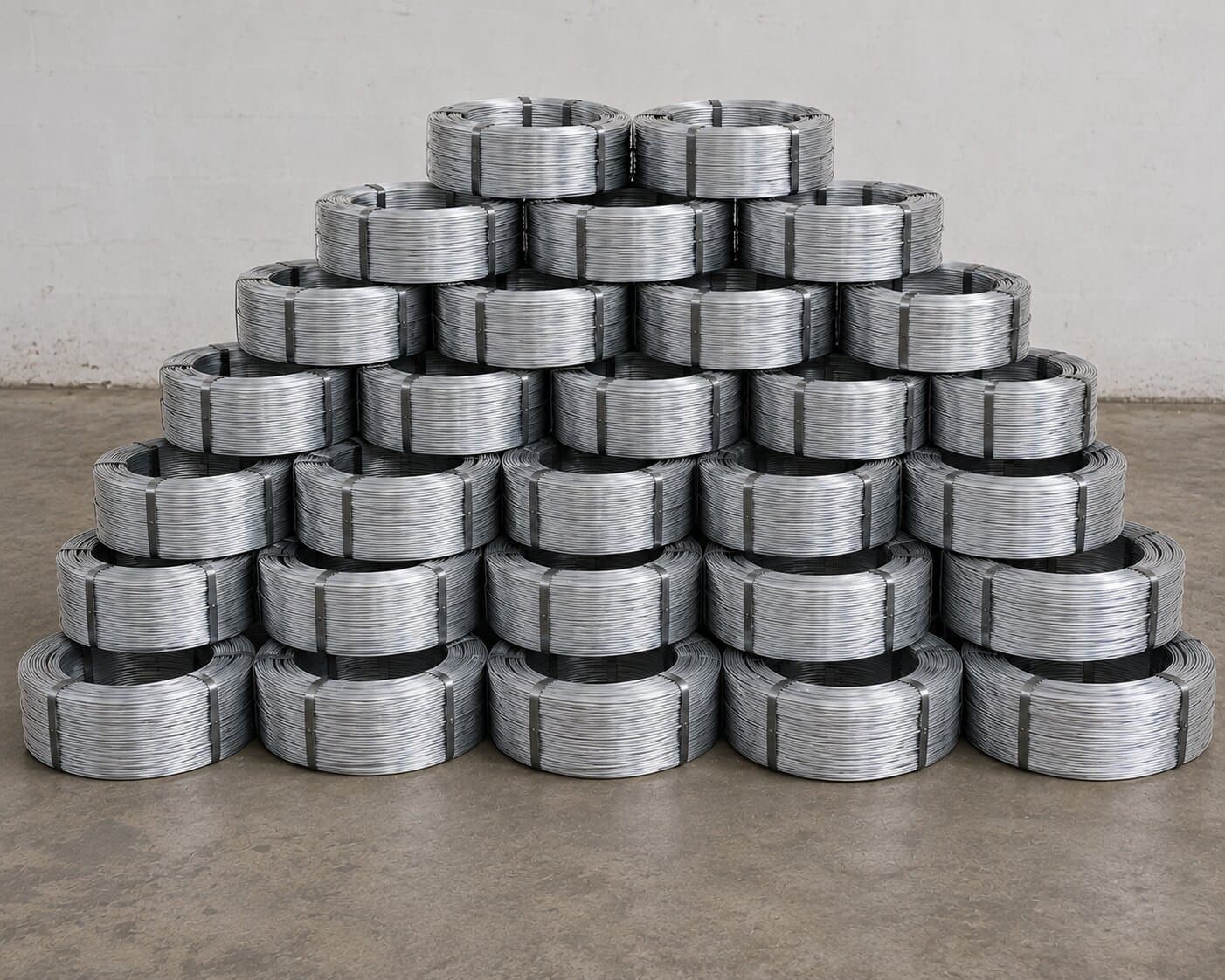
Rivet Wire
Aluminium Wire for Rivet Manufacturing
Overview
Close-tolerance aluminium wire for rivet cold-heading — consistent roundness, surface finish and mechanical properties ensure defect-free rivet heads and reliable fastener performance
Applications
Common Alloys
Properties
Manufacturing Process
Step 1
Rod Preparation
Aluminium rods of the required alloy (1100, 5056, 2017) are selected and pre-inspected for surface and composition.
Step 2
Multi-pass Wire Drawing
Rods progressively drawn through diamond-grade dies to final rivet wire diameter with intermediate anneals to restore ductility.
Step 3
Precision Annealing
Final anneal at controlled temperature ensures the soft, ductile condition required for cold-heading without cracking.
Step 4
Surface Finishing
Wire surfaces bright-finished and lubricated; diameter and roundness verified to close tolerances (±0.01 mm).
Step 5
Coiling & Spooling
Wire coiled or spooled to customer-specified coil weights for automated cold-heading machines and rivet presses.
Step 6
QC & Dispatch
Tensile strength, elongation and hardness verified; diameter and surface inspected per ISO 6892 / ASTM B316. Full material certificates issued.
Step 1
Rod Preparation
Aluminium rods of the required alloy (1100, 5056, 2017) are selected and pre-inspected for surface and composition.
Step 2
Multi-pass Wire Drawing
Rods progressively drawn through diamond-grade dies to final rivet wire diameter with intermediate anneals to restore ductility.
Step 3
Precision Annealing
Final anneal at controlled temperature ensures the soft, ductile condition required for cold-heading without cracking.
Step 4
Surface Finishing
Wire surfaces bright-finished and lubricated; diameter and roundness verified to close tolerances (±0.01 mm).
Step 5
Coiling & Spooling
Wire coiled or spooled to customer-specified coil weights for automated cold-heading machines and rivet presses.
Step 6
QC & Dispatch
Tensile strength, elongation and hardness verified; diameter and surface inspected per ISO 6892 / ASTM B316. Full material certificates issued.
Chemical Composition
EN 573-3 / AA
Max % unless range shown. Balance: Al.
| Alloy | Chem. Symbol | Si | Fe | Cu | Mn | Mg | Cr | Zn | Ti |
|---|---|---|---|---|---|---|---|---|---|
| 1100 | Al99.0 | Si+Fe: 0.95 | — | 0.05–0.20 | 0.05 | — | — | 0.10 | — |
| 5056 | AlMg5Cr | 0.30 | 0.40 | 0.10 | 0.05–0.20 | 4.5–5.6 | 0.05–0.20 | 0.10 | — |